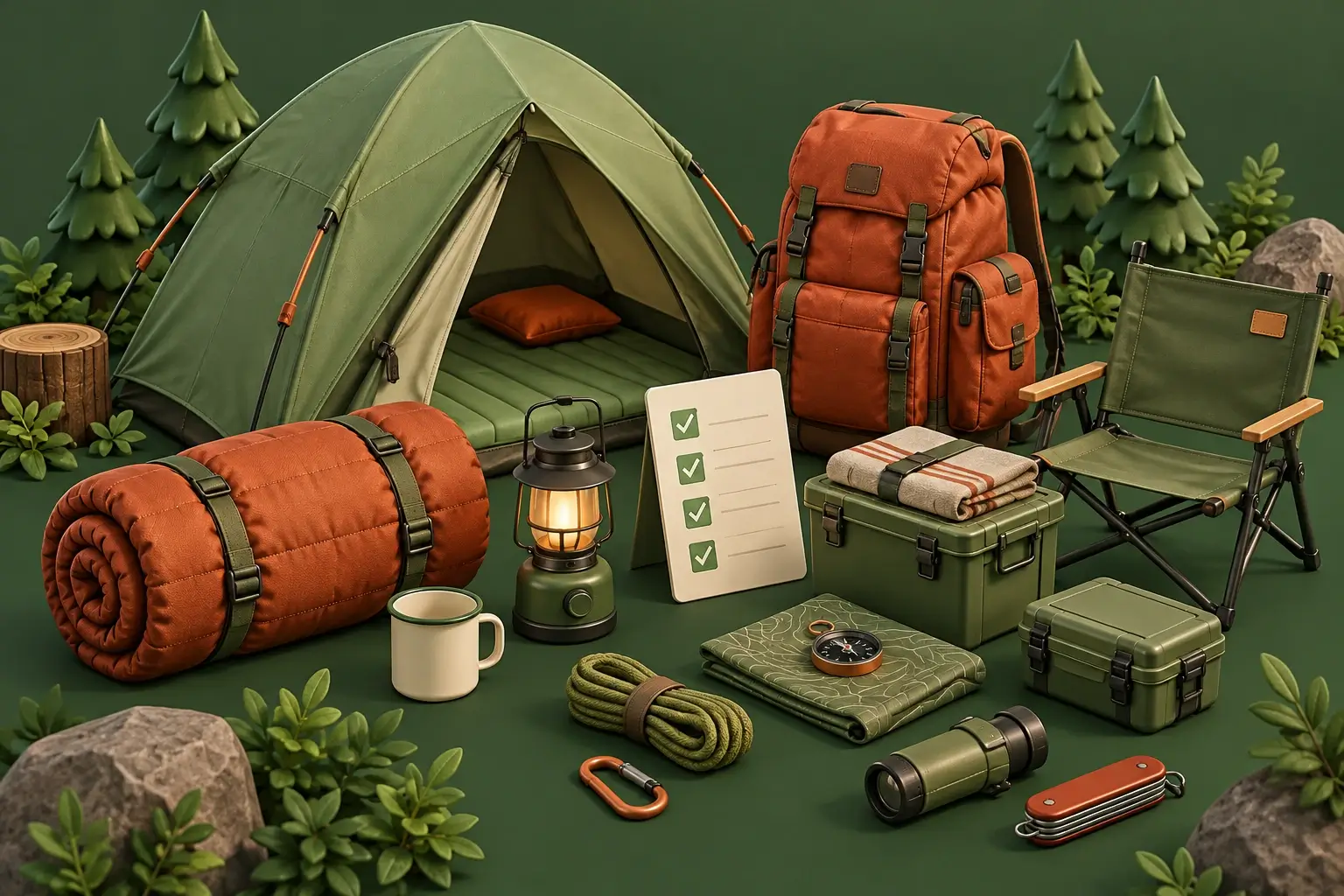
What the template assumes
Open Camp. The first screen asks "What kind of camping?" Tap Family Camping and the packing list is created right away. The card reads "25 items · 5 groups", with the summary "Essential car camping gear: tent, cooking, bedding, and kids' items." So car camping here means driving to a campsite and pitching a tent near the car for at least one night.
Camp's separate Car Camping template is for sleeping inside the vehicle (car camping guide). The backpacking guide is for carrying everything on foot. Only the family template has a group for children.
The labels quoted here come from Camp's English interface. In the edit screen, items show up one per line with no group headings, but they stay in group order: shelter at the top, kids' items at the bottom.
The 25 items in five groups
| Group | Items | Count |
|---|---|---|
| Tent & Shelter | Tent body, Rainfly, Stakes & mallet, Groundsheet, Tarp & poles, Guy lines | 6 |
| Bedding | Sleeping bag, Sleeping mat or air mattress, Pillow, Blanket | 4 |
| Cooking | Stove & gas, Cookset & frying pan, Cutlery & dishes, Cooler box, Water bottle, Food & ingredients, Trash bags | 7 |
| Furniture & Lighting | Table, Chairs, Lantern, Extension cord & power strip | 4 |
| Kids & Other | Kids' spare clothes, Toys & games, First-aid medicine, Wet wipes & tissues | 4 |
Cooking is the biggest group, and the one that varies most with headcount and menu. Decide the meals first. Food quantity and cooler size follow.
The six shelter items are a different case. If one is missing, there's rarely a fix at the site. Even missing stakes or guy lines can keep a tent from standing, so open the tent bag and look before you check it off.
Pack one more set of kids' spare clothes than the number of days you're staying, since children get wet and muddy fast. First-aid medicine should cover antiseptic, bandages, a fever reducer, bite ointment, and any regular medication.
What to bring no matter what, and what you can rent or skip
Short on space, or heading out for the first time? Sort what's hard to replace from what has a substitute.
Pack the sleeping bag, sleeping mat, lantern, first-aid medicine, water bottle, and trash bags. Cold nights, darkness, and a sick child leave you few alternatives. If the campsite rents tents or has pre-pitched tent sites, the whole shelter setup can stay home. And if it rents grills or sells charcoal, you can lighten the stove and gas.
Other items have easy substitutes.
- A car-side awning or the campsite's shared shelter can stand in for the tarp and poles.
- For a short stay, a folding crate or a cooler topped with a board works as a table.
- A ground mat with cushions can replace chairs, and low folding stools suit children.
- You only need the extension cord on an electric pitch. Without power, use power banks and USB lanterns.
- A cooler bag with ice packs, or shopping locally on the day, cuts down the cooler space you need. Frozen water bottles double as ice packs and turn into drinking water as they melt.
- A fleece can stand in for a blanket, and a pillow from home or a sack of clothes can replace a camping pillow.
Separate shared gear from personal gear
Every template item sits on a single line, so a family of four still sees just one "Sleeping bag". Sort items by type before you assign them to people and the split is obvious.
| Type | Items | Who takes it |
|---|---|---|
| One per campsite | Tent body, Rainfly, Stakes & mallet, Groundsheet, Tarp & poles, Guy lines, Stove & gas, Cookset & frying pan, Cooler box, Table, Lantern, Extension cord & power strip | The owner, or whoever loads the car |
| One per person | Sleeping bag, Sleeping mat or air mattress, Pillow, Blanket, Chairs, Cutlery & dishes | Each person or each family |
| Scales with people and menu | Food & ingredients, Water bottle, Trash bags, Wet wipes & tissues | Whoever does the shopping |
| For the children | Kids' spare clothes, Toys & games, First-aid medicine | A parent or guardian |
Say two families share one pitch. Each brings its own tent, but one tarp, table and stove can serve everyone. A single "Tent body" line can't tell two tents apart, so add "Tent body (Lee family)" and "Tent body (Park family)", then delete the original. Do the same for anything that would ruin the night if forgotten, like sleeping bags.
In Camp you can't rename an item, so delete it and add it again. New items appear at the bottom. Items you enter yourself stay unchanged when someone switches the screen language, but template items switch between English and Korean automatically.
Assigning items in Camp
- Tap Family Camping. The "Editing" view opens with the title "Family Camping Checklist". Tap the title and add a date and place, like "Lake weekend, Nov 14". Press Enter or tap outside the field and it saves.
- Delete what you don't need with the trash icon. If the campsite rents tents, remove Tent body and Rainfly. If there's no power, remove the extension cord.
- Type missing gear into "Add item (e.g. Board games)" and tap "Add".
- Tap "Assign" next to an item and type a name of up to 20 characters. Press Enter or tap outside to save it. Clear the name to remove the assignment; Escape closes the field without changes.
- Once an item has an assignee, buttons appear above the list: "All" plus one for each name, each with an item count. And as long as some items have no assignee, an "Unassigned" button shows up too. Tap it to find gear nobody has claimed.
- Use "Share & Assign" at the top to create a share link, then send it to the other family.
Name buttons group items only when the assignee text matches exactly, so "Sam" and "Sam's family" end up as two buttons. Agree on a single spelling.
Users with the share link can see assignees and filter by name, but they can't reassign. Link types and reissuing are covered in Divide camping gear and check it together.
Adjust for the season and campsite
The template doesn't account for the season. So a few days before you leave, check the forecast and the campsite's rules, then edit the list.
- For cold nights, compare the sleeping bag's temperature rating with the expected low. Much of the chill comes from the ground, so an extra mat layer helps.
- On an electric pitch, make sure the extension cord reaches the outlet. Some campsites limit power draw or appliances, so read their rules.
- In hot weather, shade from a tarp matters most. The template lacks insect repellent and sunscreen, so add both.
- If rain is forecast, fold the groundsheet under the tent floor so it doesn't stick out and collect water.
- If fires are allowed, add a fire pit, firewood, heat-resistant gloves, and water for putting the fire out. The template has no fire items.
- If you plan to buy food at the campsite shop or a nearby store, enter "buy there" as the assignee for Food & ingredients so nobody packs it by mistake.
Heating and fire safety in a tent
The biggest hazard on family camping trips is burning fuel in an enclosed space. Carbon monoxide has no color or smell, so sleepers rarely notice it. And children may not be able to tell you they feel unwell.
- Never use charcoal, a fire pit, a gas or kerosene heater, or a stove inside a closed tent or a fully enclosed tarp. Even charcoal that looks finished can still give off carbon monoxide.
- On cold nights, go for flame-free heat first, such as an electric blanket on a pitch with power, and keep vents open. If you plan to use a fuel-burning heater, add a carbon monoxide alarm to the list. But an alarm doesn't replace ventilation.
- If anyone has a headache, dizziness, nausea, or unusual drowsiness, get everyone into fresh air at once. If symptoms continue, call emergency services (119 in Korea).
- Use the stove well away from the tarp roof, and check that your gas canisters are compatible with your stove. Keep spare canisters away from the fire pit and out of a car parked in the sun.
- Keep the fire pit well away from tents and tarps, skip it on windy days, and make sure the ashes are cold before bed and before you leave.
- Taut guy lines and stakes trip children at night. A lantern at the table and another at the tent door keep the paths visible.
The night before and the day you pack up
The night before, everyone taps their own name button and checks off only their own items, and only once an item is actually in a bag or the car. The top of the screen shows a percentage and a count like "Packed 12 / 25", which turns into "All packed!" when everything is checked. The "Unassigned" button goes away once every item has an owner. So if it's still there, something is unclaimed.
The same list works when you break camp. Uncheck each item as it goes back into the car; anything still checked is still at the site. And since campsite reception can be weak, watch for an error message saying a change wasn't saved.