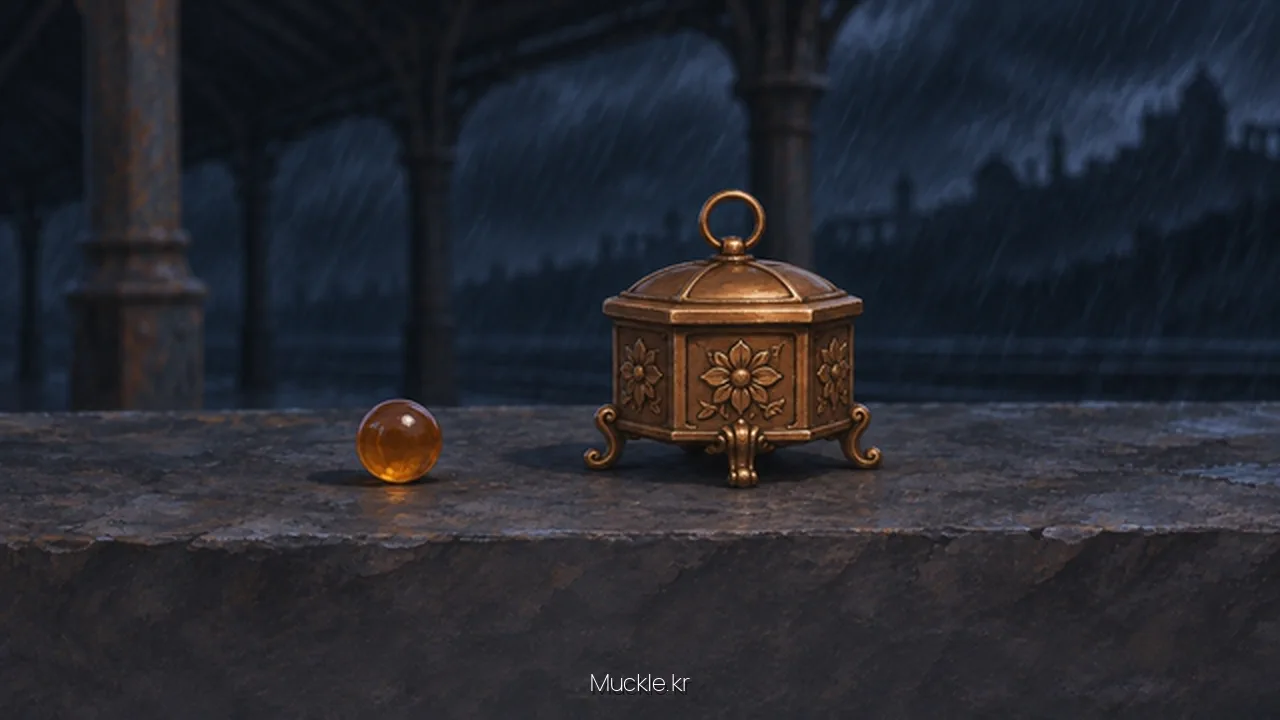
The brazier opened, but its hinge switched sides in the next shot. For Dot, our rabbit character in the 66-second First Light, we had to decide which shots to remake, repair, or keep.
We first changed the reason for the journey
The first storyboard had a repair platform at dusk, rails between rooftops, and a glass disc. We tested the ignition, rescue, and ending in Veo 3.1 Lite. Once assembled, the shots made it hard to follow why the city went dark or why Dot headed into the storm. Dot's appearance also changed between shots. So before adding more scenes, we had to repair the story's connections.
We replaced the glass disc with a tiny brazier Dot had kept since childhood. After a storm puts out the lighthouse and streetlights, Dot finds it. A flashback shows young Dot on a sunlit floor, touching the brazier and noticing a necklace beside it. Back in the present, Dot places the amber bead in the brazier. The first flame gives them a reason to take the rails to the lighthouse. Once that sequence was settled, we removed the dialogue and subtitles and let action and sound carry it.
We checked hands and props against the same references
An early ignition shot sent a hand straight through a solid part of the brazier. The brazier grew between shots, too, and sometimes came out of a drawer too small to hold it. Some shots appeared to give Dot four arms, or a right hand on a left arm. Young Dot's ears drifted from adult proportions to a size too small for the head. And in seated poses, the knees and feet pointed in directions that had nothing to do with each other.
When we remade shots in Omni 1.2, we set the brazier's size to fit one hand and swapped the drawer for a chest that had room for it. We aligned young Dot's legs and feet and adjusted the ears against the head and body. In the retrieval shot we didn't hide the hand. We generated a version with a left arm that connected naturally from shoulder to hand. The new source was three seconds, so we retimed it to four, then checked both its original frames and the edited result.
Moving the bead took smaller actions. A hand reaching for the brazier suddenly grabbed the necklace, or lifted the chain and left the bead on the floor. In present-day shots the bead grew, and Dot looked ahead instead of at it. So we split the sequence into individual shots: looking at the brazier, picking up the necklace, holding a bead of the same size, and placing it in the open brazier. Dot's eyes had to follow the bead from hand to opening.
The lid needed its own rule: stay attached to one edge and open in the same direction. We cut a shot where it came loose and used a short Flova shot of the lid opening. But the next shot moved the hinge to the side nearest Dot's arm, and another generation left a large watermark. So we composited the parts we needed from existing footage, fixed the hinge on the bead side, and kept the crossing hand in front of the lid. To check the join, we compared the last frame of one shot with the first of the next.
We chose which parts to regenerate and which to keep
Changing tools didn't remove every problem. Seedance flashbacks mixed the brazier and necklace actions, and another generation could change the bead or the hand again. Some requests to retrieve or open the brazier were rejected, so we changed the setting. Other attempts returned no video. Within the free allowance, every regeneration of good footage left fewer chances to repair the shots that still needed work.
We kept the usable Omni footage. When a single action needed fixing, such as a lid movement or a glance, we chose a short replacement or a composite. For each shot we recorded the brazier's size, the bead position, the moving hand and the hinge direction, then compared candidates against those references.
On the rails, we made Dot's reaction to the storm easier to read. A piece of paper had seemed to come out of the brazier, so we brought it in from outside the frame instead. Dot raises the back of a hand to their forehead and peers through their fingers. The cart rattles over the rail joints. Different camera positions show the distance, the expression and the wheels on the track, and the cart keeps travelling in the same direction.
We made a similar choice at the lighthouse. A new Omni clip had the wrong hinge for its first two seconds, but the following four seconds had useful movement of light. So we placed another shot of the attached lid opening before those four seconds. Dot stays on the cart, opens the brazier, and raises their gaze with the light. The lighthouse and streetlights stay dark until the light reaches the lighthouse. Then nearby lamps come on and the black clouds thin. We kept Dot's final expression from an earlier Omni shot.
We checked sound continuity and the final frames separately
The storm carried on, but the rain stopped at every cut, because we'd joined the sound from individual clips. So we laid one continuous rain track beneath the storm and mixed the cart, ignition, and score over it. The childhood scene and the city's relighting stay distinct. We joined their sound to suit each scene.
For the 720p finish, we removed the old Muckle.kr lettering from the opening and ending, enlarged the image, and rendered the lettering again. The first assembly stalled. The next file opened, but video frames vanished wherever the source clips changed color settings. So a completed encode didn't prove that every shot had survived.
We normalized the source color settings, then assembled the clean opening, body, and ending. We checked all 1,584 frames, upscaled to 1280 by 720, and rendered the lettering again. The existing music and effects track carried over. Last, we played all 66 seconds at normal speed to look for missing shots. That playback was muted, though, so it wasn't a fresh listening check of the whole soundtrack.
In the finished film, Dot's eyes reach the brazier before the bead-carrying hand does, then rise with the light at the lighthouse. Once the city is bright again, Dot looks back at the object kept from childhood. That last shot is why the brazier had to stay the same object throughout.