How the levels were built
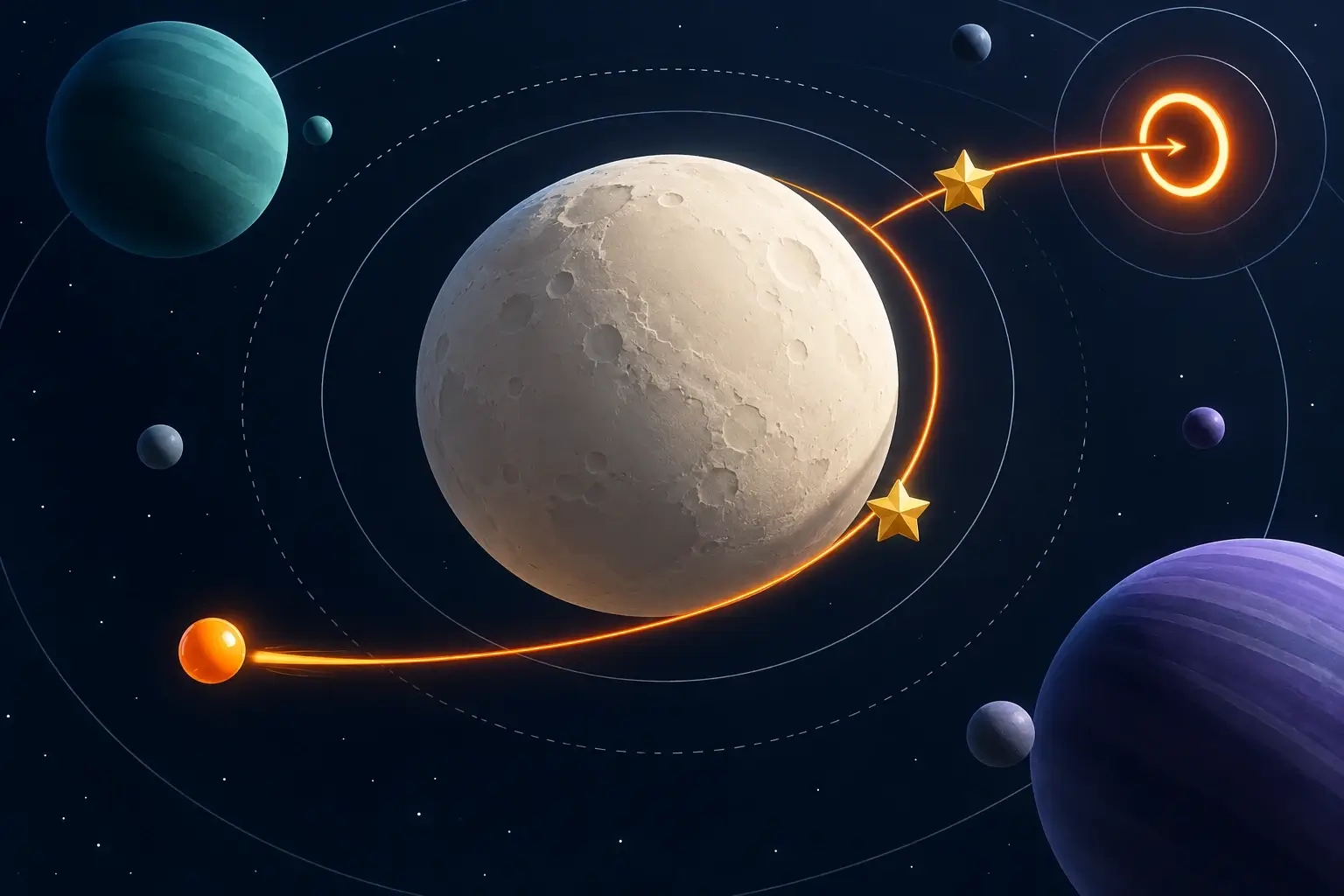
Levels 1 to 5 were placed by hand as tutorials. Levels 6 to 30 came from a generator. It builds candidates from a fixed random seed and keeps only the ones that pass its checks. For each candidate it fires 7,560 test shots using the same calculation as the game: 360 angles at 1° steps times 21 power settings from 20% to 100% in 4% steps. Several of its rules are useful to know as a player.
- The reference solution leaves some aiming room. Among the hits, the generator picks the shot with the most hits in its nine neighboring cells (±1° angle, ±4% power). If that count is below four, the layout is rejected.
- Both gold stars sit on the reference path, near the 40% and 72% points of the flight, and the reference shot has to pass through both.
- Levels 6 to 30 have no straight-line shortcut. A planet, asteroid or repulsor must block the straight line from the launcher to the target, and the layout is thrown out if even one hit strays less than 30 units from that line.
- Easy detours around the devices are blocked too. If shots that use none of the asteroids, wormholes, repulsors, black holes or moving planets occupy four or more of the nine neighboring cells (±1°, ±2% power), the layout is discarded. This check uses a finer grid: power runs from 10% to 100% in 2% steps.
- On wormhole levels, only hits that pass through a wormhole were counted, so the reference path and its gold stars go through the wormhole.
Put simply, the line through the gold stars is part of a path that really works. Paths that ignore the devices are narrow or absent.
Replaying the reference solutions with the game's own calculation gives flight times from 0.82 seconds (level 23) to 3.57 seconds (level 1). Of the 30, 27 reach the target within 2 seconds. Your rating doesn't depend on flight time. But if the Flight time on the clear screen is far above the reference solution's time for that level, that suggests you found a different route from the reference one.
The groups at a glance
| Levels | Target ring radius | Planets (moving) | Other bodies | Hit rate |
|---|---|---|---|---|
| 1-5 | 56 | 0-1 | none | 1.94-4.35% |
| 6-10 | 44 | 1-2 | none | 2.31-3.28% |
| 11-15 | 40 | 2-3 | wormhole (13, 15), asteroid (15) | 0.62-1.84% |
| 16-20 | 36 | 2-3 | repulsor (all), wormhole (17, 19), black hole (18, 20) | 0.44-1.12% |
| 21-25 | 34 | 2 (1) | wormhole (22, 24), black hole (23, 25) | 0.32-0.99% |
| 26-30 | 32 | 2-3 (1) | asteroid (all), wormhole (26, 28, 30), black hole (27, 29, 30) | 0.21-0.79% |
Hit rate is the share of the 7,560 test shots that reach the target, as recorded in each level file. On wormhole levels, only wormhole hits count. Even level 1, with no bodies at all, manages just 1.94%, or 147 of 7,560 shots. Level 26 is the lowest, at 0.21%, about 16 shots. As the ring shrinks from 56 to 32, the rate drops from 4.35% to 0.21%.
The dotted preview shows up only on levels 1, 2, 13, 15, 16, 18 and 21, where a new kind of body first appears. On every other level, you see only the faint trail of your previous shot.
Levels 1 to 5: hand-made tutorials
Level 1 has no bodies. The target sits directly above the launcher (both at x = 360), so a 90° shot at any power from 10% to 100% passes through both gold stars and enters the target. It's there to teach dragging and reading the power indicator.
Level 2 keeps the same launcher and target and adds a planet with radius 56 off to the right (x 560, y 700). The status line at the bottom reads "Fly through gold stars to raise your rating. Goal + 2 stars = 3 stars".
Level 3 moves the launcher left (x 200) and the target right (x 520), with a radius-64 planet between them. The dotted preview is gone from this level onward. Level 4 blocks the straight line with a radius-72 planet, the largest in the game.
Level 5 is different. The target sits low on the right (x 560, y 1000), only 120 above the launcher's height, while a radius-64 planet floats higher up (x 360, y 560). The reference solution in the level data fires horizontally to the right (0°) at 24% power. It's a slow sideways shot that the planet above gently lifts into the target.
Levels 6 to 15: bending between planets
From level 6 the ring radius drops to 44, and you get one or two planets. Levels 7 and 10 have just one, but it still blocks the straight line. So decide first which side to pass it on. Pass to the right of a planet and the probe bends left; pass to its left and it bends right.
Levels 11 to 15 use a ring with radius 40 and two or three planets. Level 11 has a planet with radius about 70, the biggest after the radius-72 planet in level 4. Level 13 introduces a wormhole, with a preview and the hint "Wormhole: enter one end, leave the other at the same speed". Its two ends are 482 apart. Level 15 brings in the first asteroid (radius about 31), plus three planets and a wormhole pair. Asteroids don't have gravity, so all you can do is avoid them.
On wormhole levels, speed and heading carry over, so you leave in the same direction you entered. Does a line aimed at the entrance, extended from the exit, point toward the target? That check quickly rules out most angles.
Levels 16 to 20: repulsors and black holes
The ring radius is now 36, and each of the five levels contains one repulsor with a radius of 30. Level 16 introduces it with a preview. Levels 17 and 19 each add a wormhole. Level 18 brings the first black hole, with a preview and the hint "Black hole: very strong pull. Touch the dark disc and you fail", and level 20 has one too. Level 19 has the lowest hit rate in this group, at 0.44%.
A repulsor never fails a shot when you fly through it. Its push is about a third of the smallest planet's pull at the same distance, but that's enough to counter a planet's pull and twist the path into an S. A black hole pulls as hard as a radius-78 planet, yet only its 22-unit disc makes the shot fail. So if you skim it at a distance where a planet would crash, the path just bends sharply.
Levels 21 to 30: moving planets
From level 21 on, each level has one moving planet. It sits at its starting position while you aim, then starts turning clockwise the moment you launch. Levels 21 to 25 use a ring radius of 34; levels 26 to 30 use 32. Level 21's 0.9-second preview is the last dotted line in the game.
| Level | Orbit radius | One lap | Speed per second | Also present |
|---|---|---|---|---|
| 21 | 105 | 4.37 s | 151 | 1 fixed planet |
| 22 | 84 | 5.86 s | 90 | 1 fixed planet, wormhole |
| 23 | 127 | 5.19 s | 154 | 1 fixed planet, black hole |
| 24 | 89 | 4.85 s | 116 | 1 fixed planet, wormhole |
| 25 | 152 | 7.05 s | 135 | 1 fixed planet, black hole |
| 26 | 114 | 5.20 s | 138 | 1 fixed planet, asteroid, wormhole |
| 27 | 124 | 7.87 s | 99 | 1 fixed planet, asteroid, black hole |
| 28 | 88 | 7.94 s | 69 | 2 fixed planets, asteroid, wormhole |
| 29 | 137 | 7.06 s | 122 | 2 fixed planets, asteroid, black hole |
| 30 | 116 | 5.17 s | 141 | 2 fixed planets, asteroid, wormhole, black hole |
The probe launches at 90 to 900 units per second. A strong shot passes the moving planet while it's still near its starting point; a weaker one meets it farther around the orbit. So once you have an angle, power alone lets you choose where the meeting happens. The orbit is drawn on screen as a circle. Estimate where the planet will be on that circle when your probe crosses it.
Levels 26 to 30 each add an asteroid. Level 26 has the lowest stored hit rate in the game, 0.21%. The final level, 30, packs in three planets (one moving), an asteroid of radius about 35, a wormhole pair 683 apart (the widest in the game), and a black hole, with a hit rate of 0.24%. There's no preview in this stretch, so the two gold stars are your most reliable guide.
The Daily Challenge
The Daily button in the menu opens one stage per date, using Korean Standard Time. Everyone gets the same stage on the same day. Each stage uses two or three fixed planets (radius 40 to 56) and a radius-40 target ring. No wormholes, no black holes, no other devices. Candidates hit by near-straight shots are rejected. Two gold stars sit on the reference path.
Fewer shots rank higher. On a tie, more gold stars win. The result screen shows "Today's best" along with your shot count and streak, though clearing the stage again on the same day won't extend the streak. Daily records are stored in this browser and don't affect level stars. And failures still cost lives, just like in normal levels.
The constants for gravity and launch speed are explained in How Gravity and Trajectories Work in Orbit Sling. Play at sling.muckle.kr.