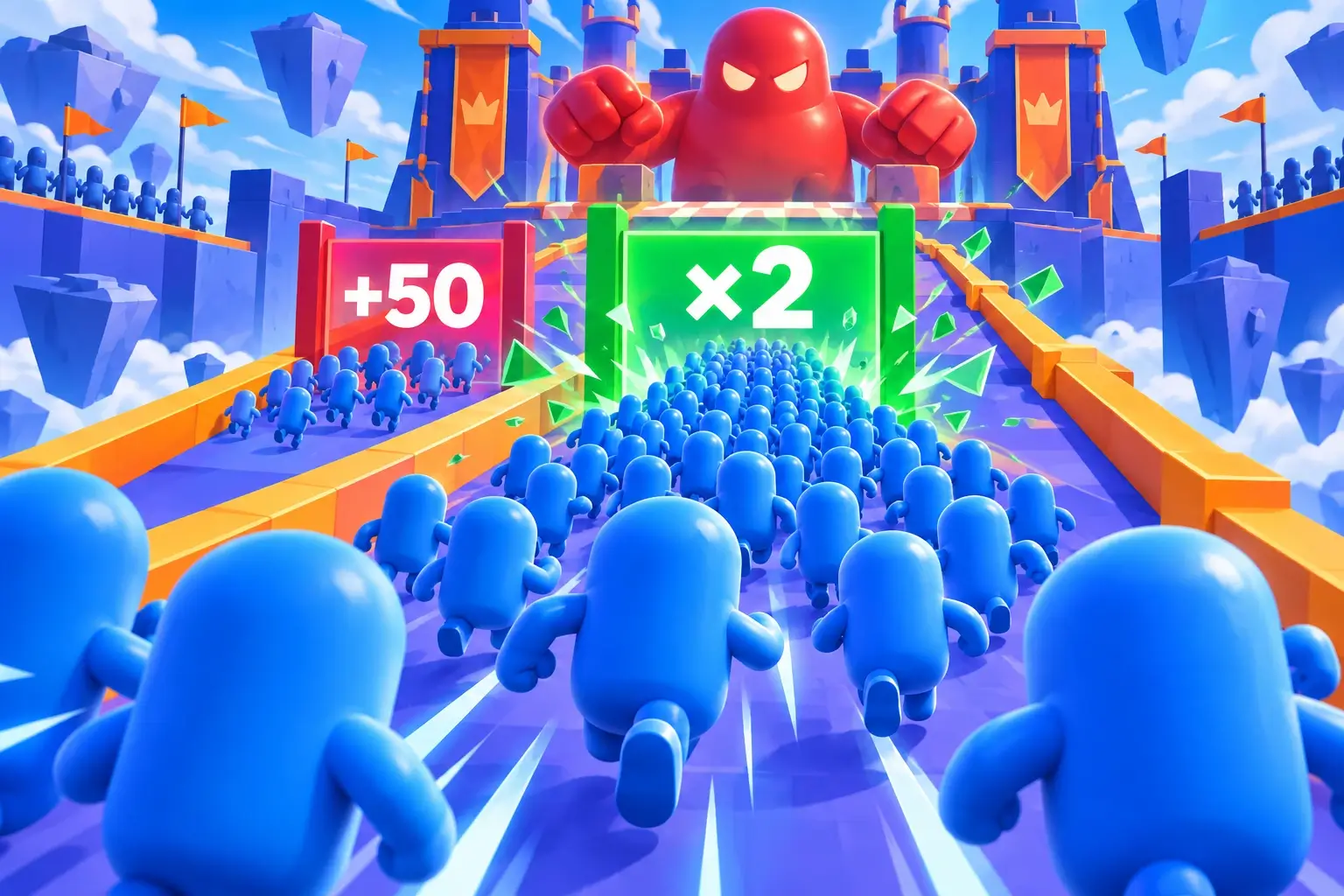
Four operations and how they apply
Crowd Rush starts you with a crowd of 10. Blue gates (+ and ×) grow it, and red gates (− and ÷) shrink it.
- Plus and times work as written, up to a cap of 99,999 runners.
- Minus can take you to zero, which ends the run on the spot.
- Division drops the remainder but never goes below 1. Seven runners through ÷2 become 3, and a single runner stays at 1.
Each row has two gates, but from Stage 3 onward there's a 40% chance a row has three. Which gate applies? The one in the lane your crowd's center passes through. If the center passes within 0.6 of the pillar between two gates, the lower of the two results applies, so riding the border always costs you.
No operation makes a larger crowd produce a smaller result. So taking the larger outcome at every row also gives the best result for the whole stage. Taking less now never pays off later.
When does times beat plus?
Rows with two blue gates need a quick calculation. With n runners, ×2 beats +k when n is larger than k, and they tie when n equals k. ×3 beats +k when 2n is larger than k. At 6 runners, ×2 versus +7 gives 12 versus 13, so +7 wins. At 10 runners it's 20 versus 17, so ×2 wins.
From Stage 4 on, some rows are all red: one minus gate and one ÷2. Here, the minus hurts less when n − a is bigger than half of n rounded down. At 12 runners, −8 versus ÷2 gives 4 versus 6, so divide. At 40, it's 32 versus 20, so subtract.
Times gates vanish once the crowd gets big. When the stage's planned maximum crowd (counted without orbs) reaches 300 + 40 × the stage number, or 340 on Stage 1, later × gates turn into + gates worth 30% of that crowd (60% for ×3). Minus gates scale up too. That's why Stage 1 has +168 and +218 from row 7.
Order and the yellow orbs
Anything you add before a multiplier gets multiplied. Ten runners through +8 and then ×2 end up at 36. Flip the order, ×2 and then +8, and they end up at 28.
Yellow orbs exploit this. Trails of five orbs appear before the first row and before 70% of the others. Each orb adds 1 plus the stage number divided by 4, rounded down, so a trail is worth 5 runners on Stages 1 to 3, 10 on Stages 4 to 7 and 15 on Stages 8 to 11. The orbs land before the gate, which means five orbs leading into ×2 are really worth 10.
Seventy percent of trails deliberately lead to a worse gate. Stage 1's first row is +15 against ÷2, and the orbs sit on the ÷2 side. Follow them and you get (10 + 5) ÷ 2 = 7 runners; ignore them and you get 25. Get just that one choice wrong, even with perfect play everywhere else, and the number of runners reaching the boss drops from 2,230 to 1,798.
But higher stages can flip this. Stage 10's first row is +7 against ×2, and the trail sits on the +7 side. Take the 15 runners from the orbs first and you get (10 + 15) + 7 = 32, against 20 for ×2. Choose ×2 there and even perfect play afterward only reaches 2,429. That's short of the stage's boss threshold of 4,016, so the stage is lost; the best route reaches 5,021. The lure is selected without counting the orbs, so as orb values grow, add them in yourself.
The best route through Stage 1
Layouts come from the stage number, so Stage 1 is the same for everyone. It has 12 rows, one minion squad, two spike fields and one conveyor belt. Row 8 is made of opaque gates, so you can't see past them.
| Row | Left gate | Right gate | Take | Crowd after |
|---|---|---|---|---|
| 1 | +15 | ÷2, orbs | +15 | 25 |
| 2 | ×2, orbs | +8 | 5 orbs, then ×2 | 60, then 54 after 6 minions |
| 3 | −6 | ×3 | ×3 | 162 |
| 4 | ×2 | −9, orbs | ×2 | 324 |
| 5 | ÷2 | +16 | +16 | 340 |
| 6 | −9, orbs | ×2 | ×2 | 680 |
| 7 | −90, orbs | +168 | +168 | 848 |
| 8 | +218 | +4 | +218 | 1,066 |
| 9 | ÷2, orbs | +12 | +12 | 1,078 |
| 10 | +8 | +287 | +287 | 1,365 |
| 11 | +7 | +374, orbs | 5 orbs, then +374 | 1,744 |
| 12 | −324, orbs | +486 | +486 | 2,230 |
Only two of the eight orb trails lead to the best gate, the ones on rows 2 and 11. The spike field after row 3 blocks the side opposite the ×3 gate, so you can run straight through. The one after row 10 blocks the right side, where +287 sits. After +287 you have about one second to slide left. The orbs on row 12 lead to −324. Follow them and you arrive with 1,425, which is under the boss threshold of 1,449 (calculated below).
Traps, minions and other hazards
If even one runner touches a spike field or buzzsaw, the crowd is cut in half (an odd-sized crowd keeps the smaller half). Your combo resets, too. Spike fields always leave a gap at least 4.8 wide on one side, and buzzsaws sweep across the track from Stage 3.
A trap costs half your crowd at that moment, multiplied by whatever multipliers are still ahead. Hit the Stage 1 spikes after row 3 and 162 becomes 81. Two ×2 gates still lie ahead, so you reach the boss with 1,906, 324 short. Hit the spikes after row 10 and you lose 683 of 1,365, and with only additions left you arrive with 1,547. Hit both, and you lose to the boss with 1,385.
A minion squad takes exactly the number shown above it, and if you have that many runners or fewer, the run ends there. That number is the planned maximum crowd at that point, excluding orbs, multiplied by 0.12 + 0.015 × the stage number (up to 0.35). A new squad is added every three stages, so Stage 10 has four. Stage 1's squad is 6, but the one after row 8 on Stage 4 is 152.
Conveyor belts run from one gate to the next (starting on Stage 2, one long belt spans two gates). They multiply forward speed by 2.24 on Stage 1, up to 3, so you've got less time to change lanes. Opaque gates hide what's behind them. After the first row, 26% of rows are opaque on Stage 1, and that climbs 1% per stage to 45%.
Red gates start pulling your crowd toward them 12 units before the row. Meanwhile the wind changes direction and strength (from 1 to 5) every 4 to 7 seconds. Wind strength is capped at 3 on Stage 1 and reaches 5 from Stage 9 onward. The pull and wind together can't exceed 60% of your steering speed, so holding the opposite direction always wins.
The boss check depends on your arrival count
The boss's strength is hidden, but the rule is fixed. First the game works out the largest crowd you could bring to the boss on that stage, orbs included. Each boss fist removes 8% of that maximum. The fists strike left, right, then both, which makes four hands in all. On every fifth stage both fists strike once more, so six in total. The boss's strength is that maximum times the win ratio, minus everything the fists removed.
You win when your crowd at the boss is larger than the maximum crowd times the win ratio, and your survivors are the difference. The ratio is 65% on Stage 1, 70% on Stage 2, 75% on Stage 3 and 80% from Stage 4. Giant-boss stages add a smash, but it is subtracted from the boss's strength, so the threshold doesn't change.
Stage 1's maximum is 2,230, so one fist removes 178 runners, all four remove 712, and the boss's strength is 737. Bring more than 1,449 and you win; the best route leaves 781 survivors. Stage 5's maximum is 832, with six fists of 67 removing 402 in total. The boss's strength is 263, so you need more than 665.
Stars and score
Stars compare your survivors with those on the best route. Reach 90% or more for three stars, 60% or more for two, and anything less earns one. On Stage 1, that means arriving with at least 2,152 survivors for three stars and 1,918 for two. A single spike hit or the first-row orb trap computed above is enough to drop you to one star.
A cleared stage scores survivors × 10, plus 100 × the stage number, plus the combo bonus, plus 5 for each runner rescued from orbs. The combo grows each time you take the best gate on consecutive rows. Each step adds 10 × the combo count, and the bonus caps at 100 points once the combo reaches 10. A perfect Stage 1 run earns 750 in combo bonus, 50 for ten rescued runners, 7,810 for survivors and 100 for the stage, for 8,710 in total. Win, and you move to the next stage with your score carried over. Lose, and the run ends.
Later stages leave less time to think. By Stage 11, speed rises from 9 to 13 and row gaps shrink from 16 to 13, which cuts the time between rows from about 1.8 seconds to about one second. So do the next row's math before you pass the current one.